

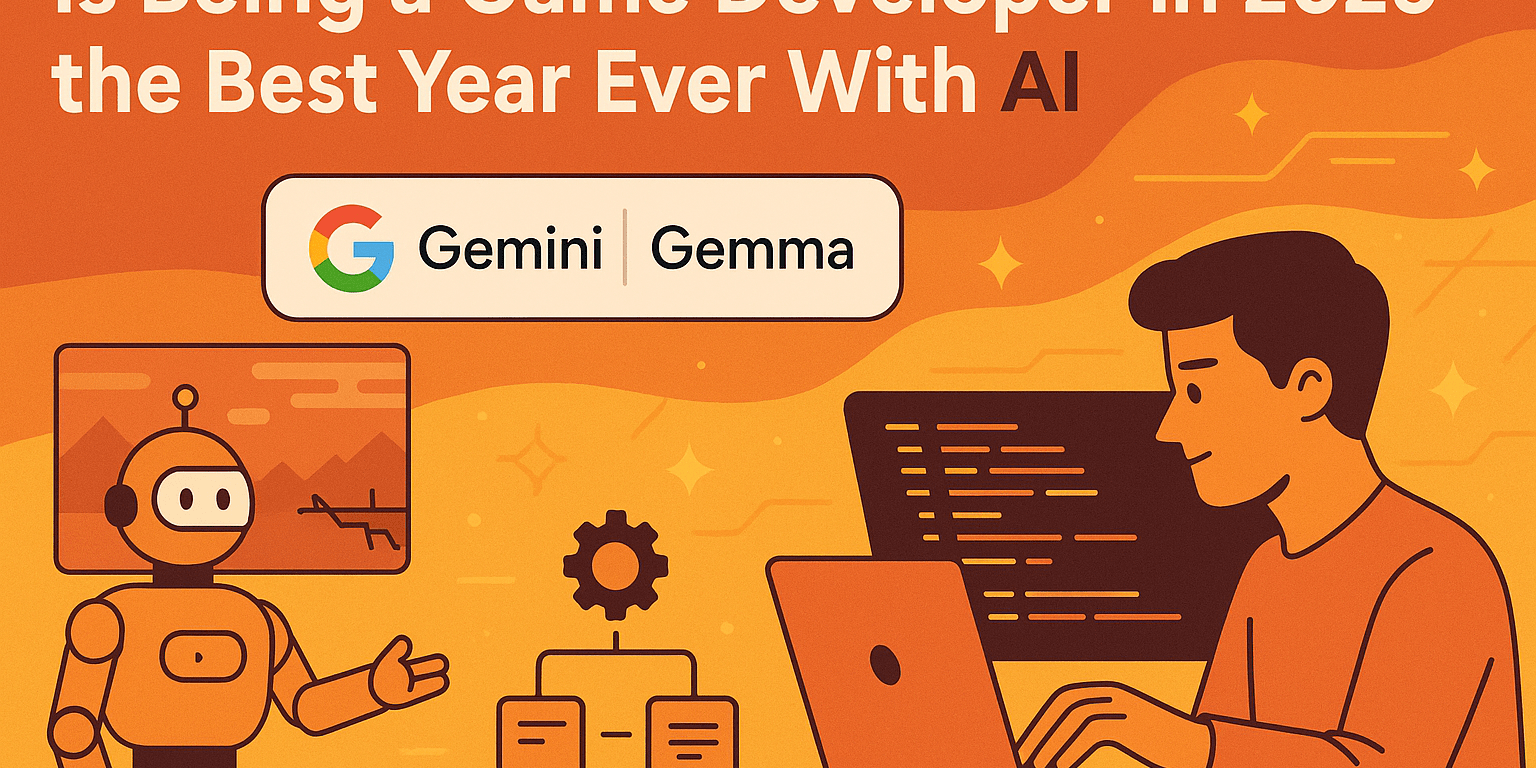
The gaming world has always evolved in waves. Indie titles took off in the early 2010s, browser-based io games blew up soon after, and then live-service shooters dominated the scene. Now in 2025, everything feels diferent. Many believe this might just be the best time ever to be a game developer—and AI is the game-changer.

How Google’s Gemini and Gemma Are Supercharging Game Devs
Google is not just sitting on the sidelines. Their Gemini models are powerful, multimodal AI sytems capable of reasoning, generating code, creating art, and more—and they’re steadily getting better with versions like Gemini 2.5 Pro, Flash, and Flash-Lite. These models are designed for complex tasks, coding, and even agentic behavior. For developers wanting real-time AI assistance, Gemini is a serious upgrade.
Meanwhile, Gemma is Google’s openly available family of AI models built on the same research as Gemini—but designed to be lightweight and accesible. Gemma 3, the latest, can run on just one GPU, supports over 140 languages, and handles both text and images seamlesly.
If you want to dive deeper:
Why 2025 Feels Like the Golden Window
Right now, tools like Gemini and Gemma are giving indie devs and small teams a real fighting chance. These AI systems can help you in every part of the process—from prototyping and scripting to balancing gameplay and generating art.
But big companies are working to make game creation so simple that literally anyone will be able to build something with a few clicks. When game-making becomes as easy as dragging and dropping into an AI engine, the market will flood with endless projects. The special creative edge that indie devs have right now could disappear.
That is why 2025 feels like the golden year. Small teams and solo developers can still move faster than corporations while also keeping their own voice and creativity intact.
FPS io Games and AI Work Together
The connection between FPS io games and AI is strong:
- Rapid updates: Developers can generate new maps, weapons, and skins quickly.
- Balancing mechanics: AI can simulate thousands of matches to find fair values.
- Player analysis: Behavior can be studied in real time to improve gameplay.
Imagine launching a new browser FPS this year. Instead of competing against massive studios with endless budgets, you can rely on AI to move faster and keep your community engaged with weekly improvments. That flexibility is what keeps io shooters alive and fresh.
The Coming Flood of Easy Games
Once Google, Microsoft and others finalize their AI systems, game development will be easier than it has ever been. Anyone with an idea will be able to create a full release without much effort. While that democratizes creativity, it also risks oversaturation. The challenge will not be building games but making them stand out in a sea of millions.
That is why indie developers have such a special window right now. In 2025, it is still possible to carve out a strong audience and build recognition before the floodgates open.
Why Players Benefit
Players are not left out of this revolution. AI-powered development means new FPS io games will arrive more frequently, feel polished from day one, and experiment with mechanics that larger companies might never risk. Gamers who want variety outside of sequels and microtransaction-driven shooters will find more options than ever before.
Conclusion
So is being a game developer in 2025 the best year of all time? Many would say yes. AI has lowered the barrier to entry and given creators the tools to compete with the largest studios. But soon, when AI becomes so simple that everyone can make a game instantly, the magic of this moment may fade.
For now, developers of FPS io games have a rare chance. 2025 is the moment to act, to experiment, and to prove that small studios and solo developers can shape the future of gaming.
 Fps Io Games